This week in math we have been adding 3 digit numbers with and without regrouping. Everyone has done an excellent job showing their work and explaining why we regroup! It's important for students to know that we regroup because we are swapping out 10 smaller units that equal the same as 1 bigger unit. 10 ones can be exchanged for 1 ten. 10 tens can be exchanged for 1 hundred and so on.
At the beginning of the week we worked with showing models of base ten blocks to visualize how we regroup.
We love doing number talks and teaching one another! We worked on using the stacking strategy and mental math to solve addition story problems today.
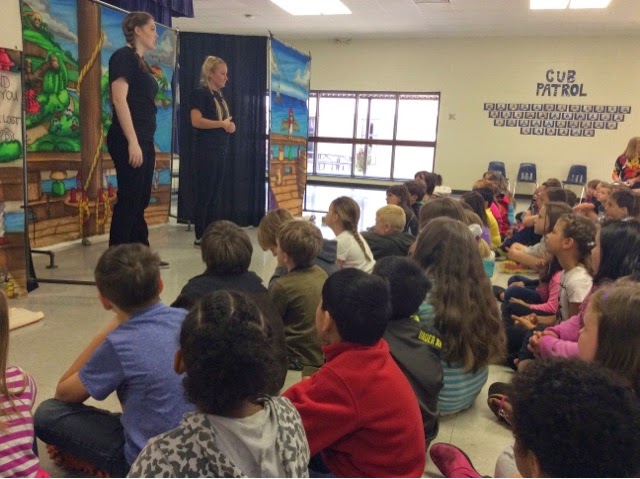
We had a great program today about natural resources and saving energy. Please sign up to receive your energy saving kit in the mail. It comes with a special treasure for the kids and it enters our school into a drawing to win $10,000. It is completly free!
Duck parenting can be tough business! We are learning all about how to care for our ducklings. We have been busy researching the best way to care for our duck eggs to make sure that their hatchability is high. We learned that hatchability is how likely it is that an egg will hatch. These are some important things we have found -
Duck eggs need to mantain a constant temperature of 99.5 degrees farenheit.
The humidity in the incubator should be around 55. We had to think back to our science unit on the water cycle to remember what humidity meant. Humidity is how much water (or moisture) is in the air. This happens when water evaporates into the air after condensation. Because of this, we have to add water to our incubators each day. We use a tool called a hygrometer to measure the humidity.
Placing water in the incubator to make sure our humidity is just right!
Our digital themometer to measure temperature and hygrometer to measure humidity.
We need to spin the ducks each day. This is because the mother duck moves around while the eggs are under her tummy. She gets up and down. If we don't spin the eggs, they may not grow properly. We put an x and an o on each side of the so we know where they should be turned next. We labeled our ducks #1-12 so we can monitor their growth in the egg.
We need to mist our eggs with water each day. Ducks LOVE the water! When a mother duck gets up and down to swim or drink water, she leaves her eggs for a little bit. When she comes back, she may still have water on her feathers, causing the eggs to get wet. We also learned that eggs are porous, meaning that air or water may get in through the egg, even though it has a hard shell.
Today was our first day candling the duck eggs. We believe that 7 of our 12 duck eggs may have baby ducklings growing inside. Each of them are Runner ducks. We have some Pekin duck eggs also, but we don't believe any of those have babies inside.
Candling duck #7. Thank you, Ms. Shaw, for letting us use your classroom to candle the eggs! Her room is nice and dark.. Perfect candling conditions! We were amazed at what we saw!
Recording our observations. Scientific data is so important! We have to monitor everything very closely!
We love blogging about all we are learning in 2nd grade! Please check out our recent posts on life cycles!
Our expectations for blogging are that we must blog about something we are learning. Each post should be at least 4 complete sentences. We are getting better every day! I look forward to seeing all your posts. You may blog at home for extra class dojo points! You can follow the link below to access our blog.